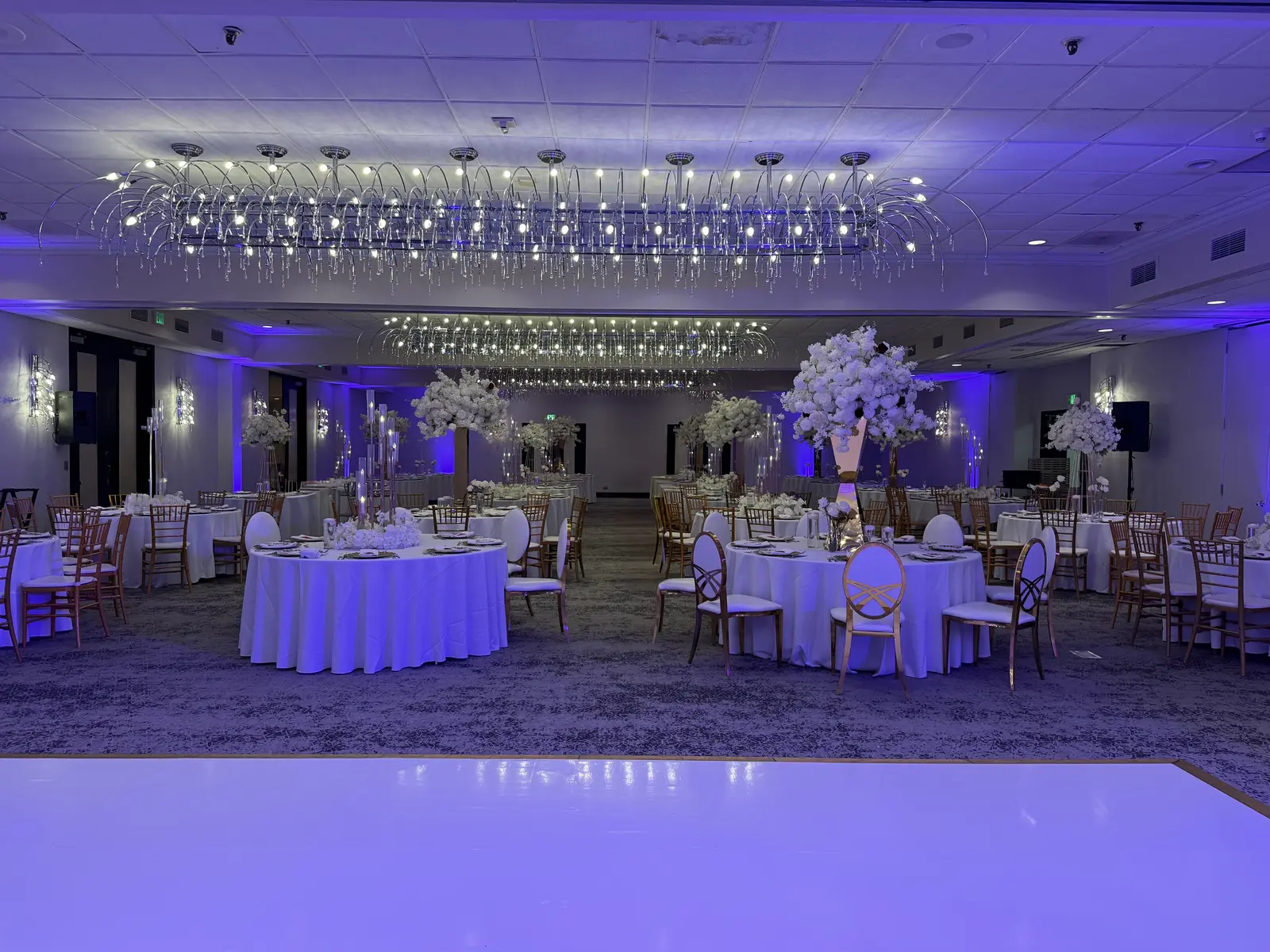
You typed "rent sound equipment for wedding" into Google and got 15 tabs open. Some vendors show a price. Most want a phone number first. A few look amazing on the site but the reviews say otherwise. You still have no idea what a wedding actually needs, or where the cliff is between a rental that makes your night and a rental that quietly breaks it.
This guide tries to be honest about the grey areas. A lot of wedding advice online is written in absolutes — "you need this, you don't need that" — and weddings don't really work that way. A setup that's overkill for a 60-person backyard can be underpowered in a 150-person barn. A speaker that sounds amazing in one room hisses in another. The right answer is almost always "it depends" — which is annoying to read and harder to write, but closer to the truth than most blogs admit.
If you want a marketing brochure, every other vendor site has one. If you want an honest look at the tradeoffs, keep reading.
Two markets, same gear, different priorities
Some quick context, because it shapes a lot of what follows. Our team has been doing events for about eight years — four of them in Minnesota, four in Ukraine before moving here. Watching both markets up close changed how we think about what matters in wedding sound.
The two markets are almost mirror images of each other.
In Ukraine, skilled service is the baseline.When you hire any working event vendor, you assume the technician knows what they're doing, the system will be set up properly, and taste will shape the room. Those are table stakes — the default expectation. What differentiates vendors, and what lets them charge a premium, is the gear they own. A vendor with a real JBL PRX or Electro-Voice EKX rig is a clear step above one running mid-tier brands, and couples feel the difference the moment the first song plays. In that market, owning the pro-line brand genuinely isthe value proposition.
In the US, it flips.The gear is the baseline here — nearly every working wedding vendor owns JBL, EV, QSC, Chauvet, Shure equipment. That's the default expectation. Which means the thing separating a $500 budget rental from a $2,000 full-service one usually isn't the gear you see in their photos. It's what happens around the gear: how it's placed, how it's tuned for the room, whether the mic actually works when the officiant picks it up, whether someone is there at 9:47 pm when the subwoofer starts buzzing. None of that shows up in marketing copy.
What's actually scarce and expensive in the US market is the skilled technician — the person who reads a room, tunes a system, and has aesthetic sense strong enough to not turn a reception into a 1990s nightclub. Most US couples never realize this is the scarce resource, because the gear photos look great on every vendor's website. It's also why the most common rental model here is self-pickup: full-service, done well by someone genuinely skilled, is expensive to offer. When it's cheap, that's usually the tell.
The thesis we keep coming back to: in a US market where almost everyone has decent gear, blind brand chasing is a waste of money. Smart quality — knowing where a pro-line speaker genuinely outperforms a mid-tier one, where a non-branded LED par is fine, and where a $200 mixer can sabotage a $40,000 wedding — is the actual skill. Most of this article is trying to unpack that.
The all-in-one model, and what it quietly trades
That market structure has a very specific, practical consequence for how wedding entertainment gets packaged and sold in the US. It's worth understanding before we get into any of the technical specifics below, because it shapes almost every quote you'll receive.
When gear is abundant and skilled technicians are the scarce thing (as we just laid out), companies can't really charge a premium for the gear — everyone has it. And they can't easily charge a premium for the scarce thing either, because couples don't know how to evaluate it. So the market naturally shifts to a different value proposition: convenience. Bundle everything into one package and sell the fact that the couple doesn't have to think. That's how the all-in-one model became the dominant format.
If you're a US couple planning a wedding, you've almost certainly already seen it. One company handles everything — DJ, photography, videography, photo booth, lighting, sometimes even coordination and event signage. You pay somewhere between $3,500 and $7,000. Everything shows up in one van, one contract, one point of contact. Every page of their site looks professional and happy.
The appeal is genuine. Why juggle five vendors if you can juggle one?
Here's the part that doesn't show up in reviews, or in the package descriptions. Bundle packages are optimized to look complete, not to be great at any one piece. An all-in-one company offering DJ + photo + video + booth + lighting at $5,000 isn't, mathematically, offering $1,000 of each. The economics don't work at those rates if every piece is done at top quality. Something always subsidizes something else. Something is always the loss leader.
Almost universally, the loss leaders are sound and lighting. Not because the companies are cynical — because couples don't know how to evaluate those specifically, and because "the music played" is a low enough bar that almost nobody complains afterward.
A tell: if you look at the sites of most big bundle-style wedding companies, you'll find lots of photos of smiling couples, DJs with headphones around their necks, open photo booths. What you almost never find is equipment specs. How many speakers. What brand line. What size. How many microphones, from which manufacturer. How much lighting, what kind, whether haze is included. That level of detail is simply absent, because publishing it wouldn't help sell the bundle.
We've seen this model from inside. At a 200-guest reception, the sound rig that rolls out of a typical bundle-company van is often two or three mid-tier powered speakers that are 10 to 15 years old, a single gig bar of lighting, and a DJ who is also the only staff member on-site. The speakers still play music. The gig bar still blinks. The dance floor still fills up. The bundle was technically delivered.
But the fidelity is not there. Anyone with a trained ear — anyone who's heard a properly scaled rig at a real event — notices it instantly. The mids are hard and fatiguing. The bass smears instead of hitting. Half the room can't hear the high end. The mic crackles during a toast. Guests don't raise their hand mid-reception and say "this sounds bad." They drink more, they dance slightly less, they take their photos and leave. Most of them have never heard a well-tuned wedding rig. They have no baseline to compare.
Then the cycle: after the wedding, the couple tells friends "the company was great, hire them." Friends book. Everyone stays on the same quality floor, because nobody in the chain has experienced what a properly built event sounds like.
This is not an argument that the all-in-one model is a scam. A lot of couples book bundle companies and genuinely have a great night. The photos turn out. The guests dance. The package gets delivered as promised. If you're budget-conscious and sound-quality isn't the thing you're optimizing for, it can absolutely be the right choice — and there's no shame in choosing it.
But: if you actually care how your wedding sounds — if music has ever moved you, if you've noticed the difference between a well-tuned rig and a mediocre one — the all-in-one bundle is probably not where your sound and lighting should come from. Verify the specific gear. Ask how old it is. Ask how many technicians are on-site during the event. Ask whether the DJ is also running lighting and effects at the same time. Ask about haze if there's lighting in the package. Almost none of these questions get asked by most couples booking bundles — which is exactly why bundle companies don't publish detailed specs in the first place.
The rest of this guide is basically a decoder for those questions. What "professional" actually means when a vendor uses the word. What kinds of speakers, mics, and lighting are appropriate for what kind of event. Where the legitimate costs live and where the padding lives. If you're the kind of couple who would rather evaluate vendors carefully than trust a bundle at face value, here's the vocabulary you'll need.
Two short companions to this guide if you want quick rules of thumb: what size speaker do you actually need for your guest count, and the 7 questions every couple should ask their audio vendor.
1. What "professional" actually means (it's a spectrum)
Before we get into specific gear, one reframe. The word "professional" gets thrown around a lot, and it means very different things depending on who's using it and for what.
A JBL PartyBox Ultimate is a perfectly professional speaker — for the use case it was designed for. It's built for backyard parties, house parties, maybe a small 30-person corporate event where the aesthetic is casual and the dance floor is relaxed. It has a DJ gesture pad on top, for context. That tells you who it's for.
Put the same PartyBox in a 150-person wedding reception at a barn in Stillwater, and it starts to show its limits. Not because it's a bad speaker, but because it was never designed for that job. Pushed hard for four hours in a big room, consumer-grade drivers and compressed DSP start to audibly struggle. The same goes for Alto, Harbinger, and most Behringer speakers — they're fine tools for their niche. Karaoke nights, rehearsal spaces, small event setups. A 150-person wedding is a different niche.
So when this article talks about "pro-line" speakers, we don't mean "the gear that has a logo you've heard of." We mean gear built for hours of hard use in larger rooms, with the headroom and the build quality to not fail on the one night that can't fail. Keep that framing as you read.
2. Ceremony sound: smaller than you think
Couples usually obsess over the reception rig and wing the ceremony. It's backwards — the ceremony is technically simpler, but it's where audio failure is most visible. If grandma can't hear the vows, you'll hear about it for a year.
For most Minnesota ceremonies in the 50 to 150 guest range, the gear list is genuinely short:
- One or two small powered speakers (8" or 10")
- A wireless microphone for the officiant
- A second wireless mic for the couple's vows
- A simple way to play processional and recessional music
That's usually it. No subwoofer, no big PA, no second rig. If the ceremony is outdoors and there's no power within reach (garden ceremony, lakeside, tent in a field), add a battery-powered option. This is the part vendors quietly forget until you're a week out and realize the nearest outlet is 300 feet from the arch.
Honest caveat: for a 20-person backyard ceremony, a good portable Bluetooth speaker with a decent handheld mic setup can genuinely be enough. We've seen couples make it work beautifully at that scale. The gear recommendations above start mattering around 40-50 guests, where voices need help carrying and the stakes of a mic cutting out are higher.
The point of ceremony audio is clarity for quiet voices — not volume, not impact. A $4,000 reception rig doesn't make a quiet bride easier to hear. A properly placed lav mic does.
For a dedicated battery-powered ceremony rig with wireless mics and an on-site technician, see our wedding ceremony sound rental packages ($444–$555, full delivery + setup).
Worth asking:"Is the ceremony going to use the same speakers as reception, or a separate setup?" Both answers can be fine depending on the venue, but a vendor who hasn't thought about it will often say "same setup" and then realize at 2 pm that the ceremony is 300 feet from the reception space.
3. Reception: where most of the budget should live
The reception is most of your night. Cocktails, speeches, first dance, open floor, last song. Get this wrong and the dance floor stays empty at 10 pm no matter how good the DJ is.
A typical Minnesota reception sound rig:
- Two powered main speakers at the front of the dance floor, 12" or 15"
- Usually a subwoofer (more on this in a second). Two for larger rooms
- For larger halls (roughly 150+ guests or deep rooms): fill speakers at the back. More on this below too
- A wireless handheld mic for the MC, toasts, and speeches
- A mixer or DJ controller with a clean connection to the system
- Enough cable to actually reach power, which sounds obvious and isn't, when the outlet is 60 feet away through a crowd
12" vs 15" mains — the part that usually gets glossed over
Most guides say "12" for smaller rooms, 15" for larger." That's only half the story. The real rule of thumb from running both: a 15" speaker on its own has more low-end impact than a 12" on its own— because a bigger cone moves more air in the 80-150 Hz range. But add a subwoofer, and a 12" + sub setup matches (and often beats) a 15" alone in total output, because the sub handles the low frequencies and the 12" runs cleaner and louder in the mids.
The practical takeaway: if you're running speakers without a sub (small cocktail events, quiet dinners), 15" is the safer call. If you're running with a sub (most receptions with a dance floor), 12"s do the job and are easier to place.
Coverage and fill speakers
The part couples rarely think about: coverage. One speaker in the corner of a 100-person room means half the guests get loud music and the other half strain to hear speeches. Two speakers angled properly give everyone the same experience. Coverage beats raw loudness almost always, and it's the first thing skipped in cheap setups.
For larger receptions — around 150+ guests, long halls, L-shaped rooms, or any space where guests at the back are >50 feet from the mains — two speakers at the front genuinely aren't enough. The people at the back end up either being blasted by the fronts (cranked to reach them) or barely hearing anything. The fix is fill or delay speakers: smaller speakers at the midpoint or back of the room, tied into the same mix, level-matched so guests at the back hear the same thing at the same volume as guests up front. Good vendors plan this into larger-room setups automatically. Budget rentals almost never do.
This is also the point where rooms start needing more than one person to set up well. A technician who knows how to level-match fills, set delay timing, and avoid phase issues is genuinely doing skilled work — which ties back to the market gap we mentioned up top.
Cocktail hour — usually its own small setup
A common assumption: "the reception system can cover cocktail hour too." Sometimes that's true — when cocktails happen right next to the reception space, same room, no walls in between. In most Minnesota venues we've worked, though, cocktails are in a separate space: a foyer, a patio, a cocktail lounge. That almost always needs its own small, non-top-tier powered speaker (a single EON or ZLX-class unit) with a line-out from whatever's playing. Nothing fancy, but skipping it usually means guests at cocktail hour get silence or someone's phone speaker.
On the subwoofer question.The honest answer is "usually yes, but not always." For a traditional reception with a dance floor, a sub is what carries the 35-50 Hz range that moves bodies. Without it, the music feels thin; people tap their feet instead of dancing. But for a cocktail-only reception, a plated dinner with background music, or a ceremony-heavy wedding where dancing isn't the point, you can genuinely skip it. Some vendors will insist you need a sub no matter what. Some will never mention it. Both are wrong.
Rule of thumb from a lot of receptions: if you're planning a real dance floor, bring the sub. If the music is meant to sit behind conversation, don't.
Worth asking:"How many speakers and where will you place them?" Not to micromanage the vendor, but to see if they've thought about it. "Two mains at the front of the dance floor" is a real answer. "However it fits" is not.
4. Microphones: the overlooked part
Here's a common misconception: that microphones are the cheap part of a wedding rig. Entry-level wired mics are, sure. Professional wireless mics are not. A single entry-level pro wireless handheld — Shure SLX-D, Sennheiser EW-D — runs $500 to $1,000 per channel. High-end systems used in demanding environments (Shure Axient Digital, Sennheiser EW-DX) run $2,000 to $5,000+ per channel. Mics aren't cheap; they just get treated like an afterthoughtdespitethe cost, because they don't make it into vendor photos the way big speakers do.
And yet, stack up every moment of a wedding where a large number of people are genuinely listening — vows, toasts, grandparents' speech, the first dance intro — and it's almost entirely microphones, not music. Paying less attention to the mic side than the speaker side is probably the most common mistake in wedding sound planning.
A typical wedding mic package:
- One wireless handheld for the officiant (ceremony), then reused by the MC at reception
- One wireless lavalier (lapel mic) or headset for the groom during vows. This one is worth paying for. Handheld mics drift away from men's chests — a lav clipped to the lapel stays put.
- One backup mic, charged and ready in the bag. At most weddings, at some point, the first mic does something unexpected. Battery, interference, a guest brushes it, a cable unplugs. The backup is the difference between a 30-second glitch and "no one heard the vows."
One technical note that matters more than couples realize: cheaper wireless mics often run on the 2.4 GHz band, same as Wi-Fi. At a venue with heavy Wi-Fi traffic or a hotel with dense networks, those mics can drop or static out. Higher-end wireless (like Shure's SLX-D or Sennheiser EW-DX lines) uses UHF frequencies that are cleaner in crowded RF environments. Not something most couples will ever ask about, but worth knowing the good vendors are paying for it.
Across years of events, the complaints we've heard about weddings have almost never been about the music. It's almost always the microphone. "We couldn't hear the speech." "The mic cut out during the vows." That's the part guests remember, and the part budget rentals skimp on first.
Worth asking:"Which wireless mic system do you use, and do you have a backup?" If the answer is vague, that's the signal.
5. Speakers: the brand spectrum (JBL and EV, really explained)
This is where most wedding blogs get lazy and just say "make sure they're using JBL or EV." That's not wrong, but it also hides a lot. Both JBL and Electro-Voice make speakers across a wide price and performance range. Knowing where on the spectrum a vendor is actually operating matters more than the logo on the cabinet.
JBL, roughly from consumer to professional
- PartyBox — built for house parties, short weekend events, casual DJing. Has Bluetooth, some models have built-in gesture pads. Warranty is typically 1 year, which tells you the expected duty cycle. Fine speaker for its category. Not built for 150-person weddings.
- EON— where JBL's actual professional line starts. Built-in mixer, DBX DriveRack DSP with automatic feedback suppression. Warranty is 7 years on the current EON 700 series specifically (for units purchased after April 2022, with registration required — so if you bought an older EON model, or never registered, you got the standard warranty). JBL's warranty program is a useful quality signal — companies don't offer 7 years unless the units are reliably built. Solid choice for small to midsize weddings, ceremonies, corporate events.
- PRX— JBL's loudest portable PA line. 2000W amps, heavier cabinets, real DSP control via an app. This is where you're into gear made for full reception duty at any venue size. PRX is the sweet spot for most wedding rigs — pro performance, still moveable by one person.
- SRX— fully professional, touring-capable. Different driver components, network control, the kind of thing that lives in permanent installations and on tour buses. Overkill for a single wedding unless you're in a 300+ guest hall with a big dance floor.
Electro-Voice, roughly the same spectrum
- ZLX— the value line. Released in 2013 as EV's way of bringing professional performance to an accessible price point. Lightweight, portable, surprisingly capable for the money. Good for small events, not the rig of choice for a 150-person reception.
- ELX200 — mid-range. Composite enclosures to reduce resonance, solid build, still portable. Fine for small to mid-size events.
- EKX— upper mid. This is where EV's QuickSmartDSP and their SST waveguide design come in, giving more precise coverage and more headroom under load. Popular for wedding DJs who want pro-line without touring-level weight.
- ETX — top of the line. Heavier cabinets, higher SPL, premium transducers. The kind of thing you bring to a 200+ guest wedding in a cavernous venue. Reliability and headroom are the big differences at this tier.
Here's the honest part: in most small to mid-size Minnesota weddings, the difference between an EKX and an ETX isn't something your guests will hear. The difference between an ELX and an EKX matters more in a demanding room. And the difference between a consumer-grade speaker and any of the EV or JBL professional lines is very much audible, to anyone.
The practical rule: don't pay a premium for the ETX if your event doesn't need it. Don't accept a ZLX if your event actually does. The gap between "consumer" and "professional" is real; the gap within the professional tiers is smaller than marketing makes it sound.
6. Lighting fixtures: where brand matters less than you'd think
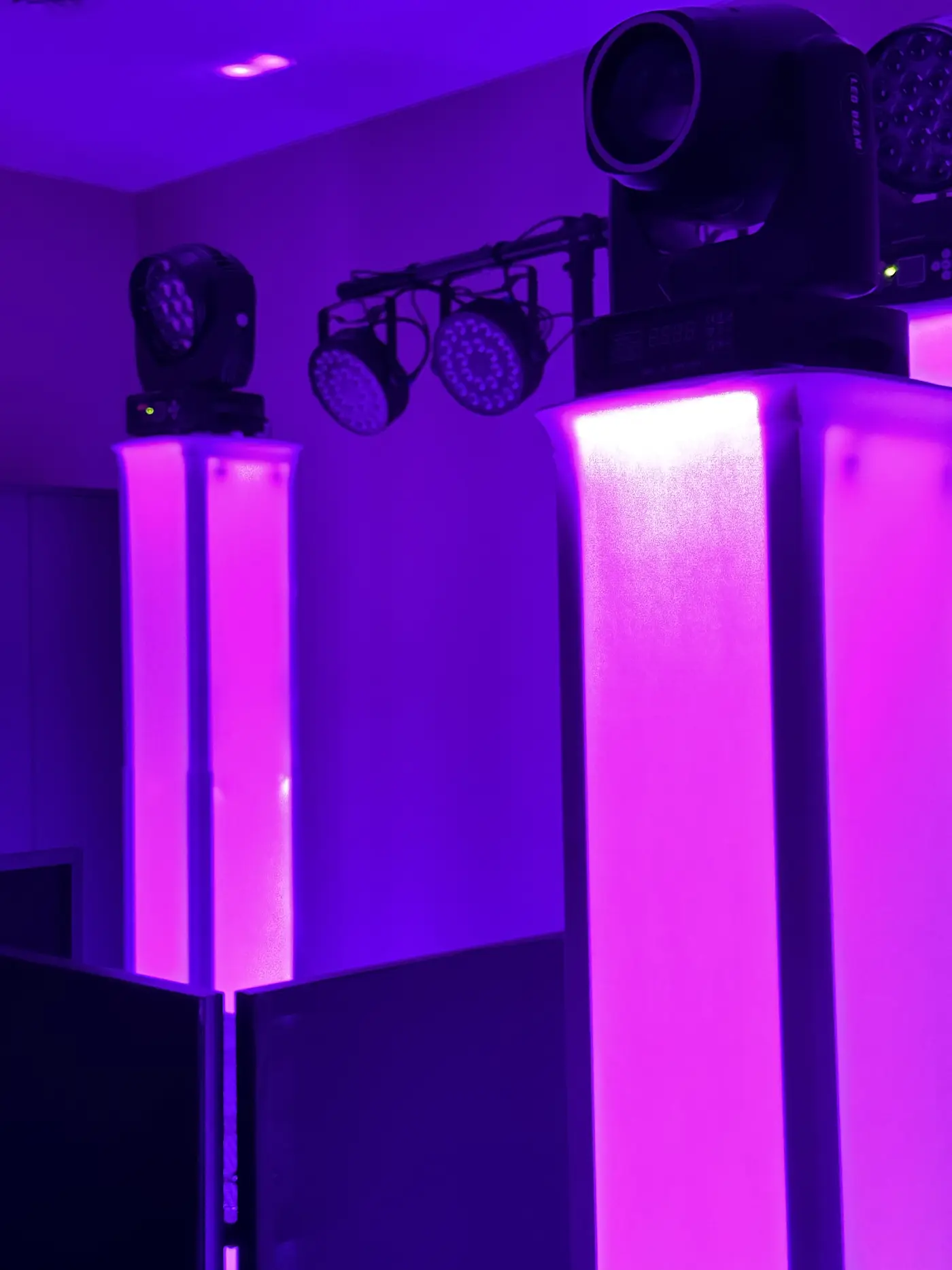
Lighting is the category where we've most often seen couples overpay for brand names and underpay for the things that actually change the room. Let's start with fixtures — the hardware that produces light. Atmospheric effects (haze, fog, dry ice) get their own section below.
Gig bars (Chauvet GigBAR, ADJ Mega Bar, and similar)
These all-in-one lighting bars are everywhere in US weddings. One stand, one bar on top, multiple effects built in — washes, pars, lasers, sometimes small moving heads, sometimes a strobe. They set up in five minutes. At the price and time budget, it's easy to see why many vendors default to them.
The honest read (supported by forum and customer reviews on Sweetwater and zZounds): gig bars do a real job. They work fine for smaller venues, backyard events, and casual receptions. They struggle in larger halls where the throw isn't enough. The moving heads have limited controllability. And because the effects are pre-packaged, the aesthetic often comes out uniform — mostly kinetic color strobes, lots of movement, a DJ-booth energy.
This is not a judgment on the gear — a gig bar does what it was designed to do. The question is whether that energy matches the wedding you're picturing. Some couples genuinely want the kinetic club look. Others, who've spent months choosing wedding colors, end up surprised when the reception lighting strobes red, blue, green, and amber regardless of the invitation palette.
Uplighting (LED pars, usually 6-12 fixtures around the room)
Uplighting is the rental that actually transforms a room. 8 to 12 small LED fixtures placed around the walls, washing the space in the couple's wedding colors. Warm tones during dinner, deeper or more saturated tones as the dance floor opens. Intentional, photographable, and calm enough to not compete with the food or the faces.
And here's where brand matters less: a decent non-branded LED uplight from a reputable manufacturer will usually perform within 5 to 10 percent of a Chauvet or ADJ unit at a fraction of the price. Guests aren't noticing beam quality or color accuracy at that tier. What they notice is coverage. Spending on 12 non-branded uplights usually beats 6 brand-name ones thinly spaced along one wall.
Moving heads — a note on why we don't call these "overkill"
Moving heads get a bad rap in "what you don't need" articles, and that framing is wrong. The issue has never really been guest count — a small, beautifully programmed moving head sequence at a 20-person reception can be stunning. The issue is programming and taste. A pair of moving heads doing slow, coordinated sweeps that match the music can genuinely elevate a room. Eight of them strobing rainbow patterns during grandma's speech don't.
When evaluating a moving-head package, the question to ask isn't "how many?" It's "how will they be programmed, and does this vendor's portfolio show lighting they'd call elegant?" Two thoughtful beams is different from eight chaotic ones at any scale.
7. Atmospheric effects: haze, fog, and dry ice are three different things
This is where the "upsell" narrative commonly gets confused, because these three look similar in photos and do completely different jobs. Each deserves to be understood on its own.
Haze machines. Not an upsell. If any real lighting is being used — moving heads, beams, lasers, even dynamic uplighting — a haze machine is essentially required. Haze is a fine, continuous, almost invisible mist that lets light beams actually show up in the air. Without haze, moving heads just point at walls. Lasers look like dots instead of blades of light. If lighting is in the package and haze isn't, the lighting won't look like what you're expecting. This isn't a luxury add-on — it's what makes the lighting visible.
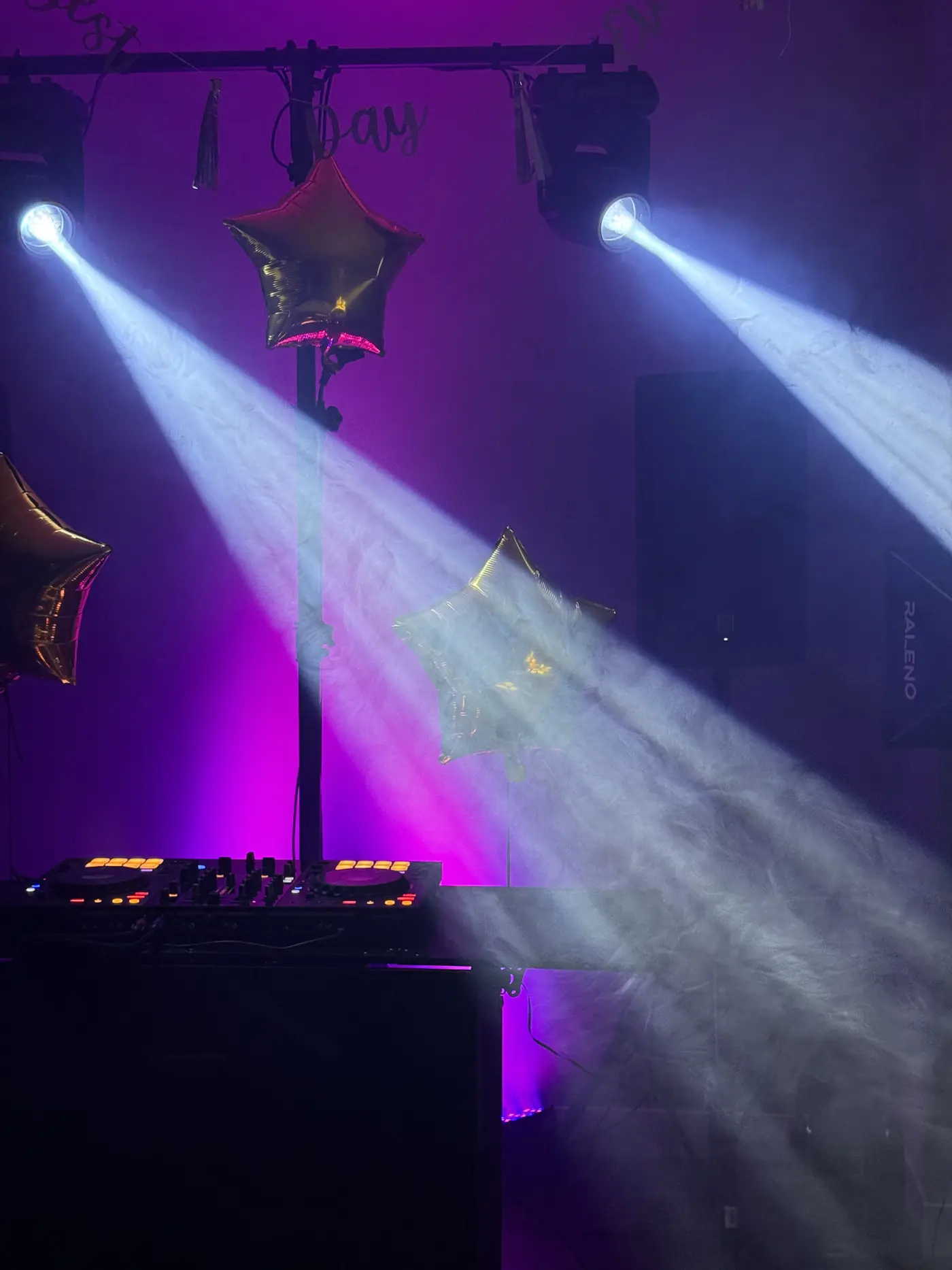
Fog machines (regular fog / smoke).This is the one we hear framed as an upsell or "overkill" the most often, and it's the framing we disagree with. Fog used at the right moments is one of the best energy tools at a wedding — two vertical columns hitting a beat drop as the dance floor goes wild, or a burst of low fog rolling into the crowd during a peak song. These are genuinely the photos people share afterward, the moments guests remember. It's not "excess" — it's one of the few effects that can reliably hype a room.
The real constraint on fog at weddings isn't whether it belongs. It's whether your venue allows it. A lot of venues ban fog machines outright because of smoke detectors and fire-code policies. Frustratingly, most professional fog fluid is water-based, non-toxic, dissipates quickly, and doesn't cause asthma or allergic reactions — but "fog is fog" to most fire marshals, and venue policy is venue policy. Ask before you book it into the package.
The one way fog doesget misused: running it continuously for the whole reception rather than in timed bursts. That fills the room, competes with dinner, and eventually gets heavy. But that's a programming issue, not a gear issue. Fog used in 10-30 second bursts at musical peaks is one of the highest-impact effects available.
If the venue allows haze but not fog, that's a workable compromise — haze for the lighting atmosphere, dry ice / low fog for the first-dance moment, and either live with no regular fog or reserve it for a specific peak the venue has approved.
Dry ice / low fog. A completely different effect: thick fog that hugs the floor instead of rising. Perfect for the first dance (couples appear to be dancing on a cloud), ceremony entrance down an aisle, or a cake-cutting moment. Short-duration effect, 30-60 seconds, and then gone. Worth it for the photos alone. Very different from a regular fog machine.
Summary: for any event with lighting, haze is baseline, not an upsell. Fog is a moment effect — fine in small, timed bursts. Dry ice / low fog is a moment effect specifically for photo-worthy beats like the first dance. Treating all three as the same thing leads to either missing the visual impact you were paying for, or suffocating your dinner guests.
See what our special effects rental covers — haze, fog, low fog, laser beam effects, and disco for the first dance and the peak of the dance set.
8. Mixers: the piece nobody asks about, and why they should
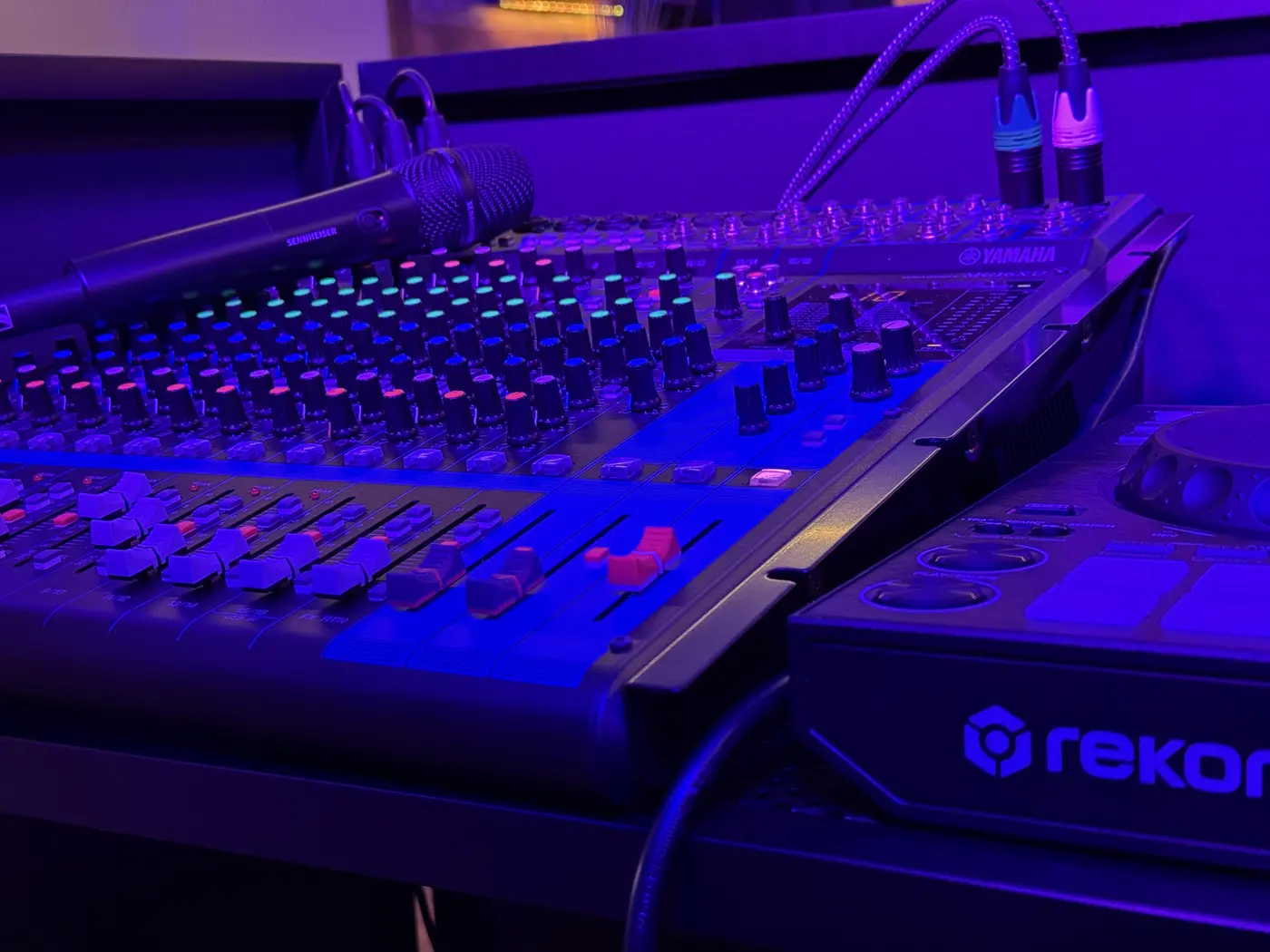
A small section for something that almost never comes up in wedding planning conversations, and probably should. The mixer (or the DJ controller's built-in routing) is the piece that takes every audio source — the mic for the officiant, the laptop playing the processional, the DJ's music, the best man's toast — and routes it to the speakers. When it works, nobody notices. When it hums, feedbacks, or introduces noise, it can single-handedly ruin an otherwise great setup.
Budget mixers — a lot of the entry-level Behringer line, for example — have historically had noticeable issues with buzzing power supplies, higher noise floor, and some reliability problems. (Several reviews on DJ TechTools and the ProSoundWeb forums note exactly this.) A more professional small-format mixer — a Yamaha MG series or a Mackie ProFX — costs a few hundred dollars more and removes almost all of those concerns. One ProSoundWeb thread describes a vendor running 15 Yamaha MG10XU units across 5,000 to 7,000 events with zero hardware failures. Budget mixers don't come close to that track record.
This matters at a wedding because mic feedback during vows is not a recoverable moment. Hum during the first dance isn't something you can edit out of the wedding video. With average US weddings running $40,000+ these days, spending an extra $200-300 on a reliable mixer versus a budget one is the definition of an invisible-but-critical upgrade. The mixer isn't where the music lives — it's where the entire night either holds together or doesn't.
Worth asking:"Which mixer or DJ controller are you using, and have you run it at this venue or a similar one?" Again, not to play inspector — just to see if they know their gear.
9. "Delivery and setup included" — a phrase doing too much work
Almost every rental site uses this phrase, and it can describe two completely different services.
One version:someone drops the speakers and a cable bag near an outlet. Twenty minutes and they're gone. If something doesn't work during the ceremony, they're already at a Culver's in St. Cloud.
The other version:someone arrives a couple of hours before guests, runs cables under tablecloths, sets each speaker at the right angle for the room, pairs the mics, does a line check with whoever is reading the vows, tunes the system to the space, and stays through the event. If a mic battery dies at 9:47 pm, they're there with a fresh one by 9:48.
Both get labeled "delivery and setup included" on websites. The difference in what you actually experience on the day is enormous. Which one the vendor means is usually not obvious from the quote — you have to ask directly.
The question that cuts through the ambiguity: "Is there a technician on-site during the event?" If the answer isn't a clear yes, assume it's the first version. Both versions have their place — drop-off is cheaper and fine for small events with hands-on couples. Just know which one you're buying.
10. The upsell list: not bad gear, often just wrong for your event
The framing here matters. The items below aren't bad gear or bad ideas. They're just often sold to couples who don't need them, because they raise the invoice. Whether they belong at your wedding depends on your specific event.
Line arrays (with subs) at small-to-mid weddings
A common upsell for couples wanting to "go premium" on sound is a line array configuration — those tall vertical stacks of speakers you see at concerts, usually on tall stands or suspended overhead. Line arrays are genuinely professional-grade gear, and they do represent a real step up over single powered speakers for the right event. They also look visually impressive in photos.
Here's what usually gets glossed over. Line arrays only actually work as line arrayswhen there are enough boxes in each stack for the individual elements to acoustically couple — that's the physics that gives an array its long throw and even vertical coverage. Most "line array for your wedding" upsells actually deliver 1 or 2 boxes per side. At that configuration, you aren't really benefiting from line array behavior. You're paying for expensive boxes being run outside the design they were built for. A well-tuned pair of point-source speakers (JBL PRX, EV EKX) will often sound more coherent in the same space, for less.
Line arrays make sense at weddings that are genuinely large enough to need them — 300+ guests, cavernous venues, throw distances beyond 80 feet. For a 150-guest reception in a typical Twin Cities venue, they're usually visual theater more than acoustic benefit.
Related upsell in the same category: subwoofers at intimate or chamber-style weddings where there isn't really going to be a dance floor. A sub's job is to add low-end weight for dancing. For a plated dinner with speeches and background music, maybe a few slow songs at the end but no open floor, the sub is paying for impact nobody will actually experience. Skip it. The room sounds better without it.
Custom gobos, floor monograms, and aesthetic light add-ons
Projecting the couple's initials onto the dance floor, a monogram gobo on a wall, custom color washes synced to specific moments — these are taste-based additions. Some couples love them, others never think twice. The cost is modest ($200 to $500 for a custom gobo), so they're not a major budget threat on their own.
The reason they appear in this list: they get sold alongside sound packages as "premium add-ons," and couples sometimes end up quietly reallocating budget from sound quality to aesthetic light. That trade almost never goes the right direction.
Bad sound is something every guest registers — not consciously, but in how long they stay, how much they dance, how distinctly they remember the night. A missing floor monogram is something that didn't happen. Nobody notices its absence. If you're choosing between a proper on-site technician and a custom gobo, the technician wins every time. Design is personal taste; sound quality is the foundation everything else sits on.
Karaoke machines as a wedding add-on
The karaoke upsell at weddings usually involves a dedicated unit — a screen, a mic, a pre-loaded song library — rolled out as a premium add-on. The gear being brought for these is often legacy equipment. Units that were genuinely professional eight or ten years ago, but now look and sound noticeably dated: worn hardware, limited libraries, low-resolution displays, and audio that doesn't match what the main PA is doing.
If karaoke actually matters for the event, two honest paths:
- Ask the vendor specifically what karaoke gear they're bringing, how old it is, and whether it routes through the main sound system or sits on its own. A dedicated wireless mic into the main PA plus a laptop or tablet running a current karaoke app will almost always sound and look better than a decade-old standalone unit.
- Or skip the "official" karaoke package entirely. Free and paid karaoke platforms run on any laptop or tablet. Use the main rig plus a spare wireless mic. Quality is usually higher, cost is lower, and nobody has to stare at a screen that looks like it came out of 2012.
Photo booths — worth rethinking the premise
Rental photo booths are standard wedding upsell territory, usually $600 to $1,500 depending on backdrop, props, print quality, and hours. The pitch: "everyone has a photo booth, guests expect it."
What we've seen at events: most rental photo booths deliver mediocre output. Prints are small and inconsistent, digital files are often compressed, backdrops feel generic, and the whole experience can end up feeling more gimmicky than charming, especially after the first hour when the novelty wears off.
Worth asking what the actual goal is. If it's casual, fun photos for guests to take home, a few Polaroid Instamax cameras on the tables ($80 to $120 each) can deliver something more personal, more tactile, and better-looking. Guests take each other's photos. Prints come out instantly. They keep them or stick them in a guestbook. Cheaper than a booth, often more fun, and the results don't feel generic.
If a photo booth is non-negotiable for your event, at least look at the vendor's real sample output before committing — ask for recent event photos, not the marketing gallery. Quality varies wildly between operators.
What's genuinely worth paying for across all of these categories: backup equipment, on-site support, real coverage across the room, and someone who sees the aesthetic of the space rather than just running the equipment. Everything else is a line item someone added to the invoice.
11. The pricing opacity problem (and what real Minnesota numbers look like)
Honest admission before we get into this: this section is the one we most wanted to skip, because the honest answer to "what does wedding sound cost in Minneapolis" is a frustrating one. Pricing in this industry is opaque in a way that would be unusual in almost any other service category. When researching this piece, we couldn't find a single Twin Cities vendor openly publishing what it actually costs to deliver, set up, staff, and run a wedding-appropriate sound system. Not one. We've walked into rental warehouses in person and asked directly — and gotten "well, it depends, we'd need to calculate, delivery is separate, tech is separate, it varies" as the answer, from people who price this for a living. Imagine calling a hotel and getting that response when you ask the nightly rate.
It's not malice. It's how the market has settled. Every vendor is afraid of being the first to show real numbers because transparency invites comparison, and comparison exposes the value gaps. The easy strategy is to post a "starting at" loss-leader that doesn't reflect a real wedding price, and sort it out in the quote call.
It's worth stepping back for a second to ask whyspecific vendors behave this way on an individual level, because the behavior tells you something about what kind of interaction they're setting up. If a service provider is afraid to list prices on their website, what are you actually dealing with? A vendor with clear public pricing is confident in what they sell and invites you to compare. A vendor who hides numbers behind a quote call is usually doing one of three things: loading up the phone conversation with add-ons and upsells you didn't ask about, pulling you into an office meeting where the social dynamic of "sit down, have a coffee, let's build a custom package" makes "let me think about it" much harder to say, or simply not wanting you to have the time to research. Because if prices are on the site, you can compare five vendors side by side. You can Google the specific gear models. You can ask an AI tool to break down whether a quoted speaker matches the advertised coverage for your guest count. You can find the cheaper alternative two clicks away. A quote call quietly strips all of that away. The information asymmetry is by design, and it works in the vendor's favor, not the couple's.
None of this is illegal. It's just a specific sales posture. But it's worth recognizing for what it is before walking into it. Vendors whose pricing isn't at least broadly visible publicly are implicitly telling you: "we'd rather control this conversation than let you shop with a clear head." You can absolutely still work with vendors like that — some excellent ones operate this way, especially at the very top of the premium tier. But the dynamic is worth naming.
The practical consequence of all of this: if you're basing your sound budget on what vendor websites show, you're under by a factor of 2 to 4. Real quotes look very different from advertised numbers. Here's what the research actually shows.
Concrete examples of the traps this opacity creates:
- Twin Cities Wedding DJs lists $495 as their lowest number. Reading the fine print: that rate is for a daytime event ending by noon, up to 4 hours. That's not a wedding. A real Saturday wedding reception in peak season is $795 on their pricing — still a budget DJ tier.
- ProDiskJockeys advertises "starting at $295." That's a 3-hour budget commodity DJ. A real wedding package with them is multiples of that.
- Companies like Bellagala and Instant Request (well-known Minneapolis names) don't publish pricing at all — their sites are "contact us."
- DJ Sound Productions is one of the more transparent ones, showing $795 (Mini, 3-hour Sunday-Thursday) up through $3,795 (Ultimate Supreme with photo booth and karaoke, Friday-Saturday). Most real weddings with them land around their Ultimate package, $1,695-$1,895.
What the data actually says, from sources that aggregate across vendors: The Knot's 2025 Real Weddings Study reports an average wedding DJ spend of $1,689 nationally. The Knot and WeddingWire show a typical Minneapolis range of $895-$1,995 for a DJ covering ceremony and reception. Premium and top-tier Minneapolis DJs run $2,000-$4,500, with well-known name DJs going $5,000-$10,000+ (often with travel, hotel accommodations, and meals written into the contract).
So the real Minneapolis wedding DJ market, tiered honestly:
Budget / commodity DJ tier — $500-$1,200
The tier where most of the published "starting at" numbers actually live once you filter out daytime and micro-wedding rates. Usually newer DJs, smaller setups, limited flexibility. Some are great value, some deliver exactly what you pay for.
Mid-tier professional DJ — $1,500-$2,500
Where The Knot's $1,689 national average lives. Experienced DJ, reliable gear, full wedding coverage, some programming flexibility. The practical floor for a "solid" wedding DJ in the Twin Cities.
Premium DJ — $3,000-$5,000
Established names with strong portfolios, high-end gear, often a dedicated assistant on-site, ceremony + reception fully covered, usually including lighting. Where attention to detail actually shows up.
Top-tier and name-recognition DJs — $5,000-$10,000+
Names people recognize. Usually travel fees, hotel accommodations, and meals are part of the contract. Often booked 12 to 18 months in advance.
All-in-one bundles — $3,500-$7,000
Photo + video + DJ + booth + lighting. Consistent range across major bundle companies nationwide. See the all-in-one section above for what that pricing structure quietly does to the sound and lighting components.
Standalone sound rental with dedicated on-site technician (no DJ)
This is the category that's largely invisible from the outside. Very few Twin Cities vendors publish pricing for it. In researching this article, we couldn't find a single local vendor offering a full "we come, set up, run it, stay on-site, tear down" package for a wedding at a publicly listed price. It's "call for quote" everywhere. The honest answer is that this product exists but is priced one-off, and the couple has to work for the number.
The bigger point: if you're basing your sound budget on what vendor websites show, you're going to be under by a factor of two or three. Real quotes look different from advertised numbers. That's the pricing opacity to plan around.
Travel fees — ask directly, the rate is only half the answer
Some vendors offer free delivery anywhere in the Twin Cities metro. Others charge $0.50-$0.80/mile beyond a free radius. A few use flat trip fees. The tricky part: per-mile fees often get billed across two trips (delivery and pickup) or four (delivery, setup, breakdown, pickup), so a $0.80/mile quote can quietly become $3.20 of round-trip travel per mile. Ask how travel is billed, not just what the rate is.
12. Three ways to rent (all of them can work)
There isn't a universal right answer. What fits your wedding depends on your event, your budget, and how much you want to think about audio on the day.
DIY pickup
Cheapest option. You drive, you pick up, you set up, you return the next day. Saves several hundred dollars over full-service. Works if you have a tech-confident person, a backyard event under 50 people, and a vehicle that fits speakers. For a wedding, it works when the setup is small and the stakes are low.
Delivered rental
Middle ground. Vendor delivers and sets up. You or your DJ runs it. Works when you have a DJ you trust and the event runs continuously. Weaker when ceremony and reception are in different spaces or when something needs adjusting mid-event and nobody on your team knows the gear.
Full-service
Vendor handles everything. You don't touch a cable. Works for weddings where the budget allows it and the experience matters more than the savings. The thing you're paying for isn't just labor — it's having someone in the room who knows the gear and can respond when something goes sideways.
Honest take: for a Minnesota wedding under 150 guests, full-service sound for around $1,000 to $1,500 is where most couples get the best value. If that's outside your budget, delivered rental with a strong DJ is a solid plan B. DIY pickup for a wedding can work, but most of the "something went wrong" stories start there.
How to actually think about this
If there's a single takeaway from all of this, it's that wedding sound isn't a shopping problem — it's a judgment problem. Almost every vendor you'll talk to has capable gear. The decisions that shape your night are more about where to invest the quality dollars and where to accept "good enough."
Invest in: pro-line speakers for the reception, real wireless mics with a backup, a technician who stays on-site, and enough lighting coverage for the whole room. Accept "good enough" on: non-branded uplighting, a mid-tier moving head if you want one, and gear you don't actually need for your specific event.
Ask vendors specific questions. Expect specific answers. When something sounds vague — "professional gear," "full setup included," "top-of-the-line" — that's usually where the gap lives.
Weddings happen once. The gear is just the medium. What actually matters is who's holding it together when the mic cuts out at 9:47 pm.
Planning a wedding in Minnesota?
SoundMN has handled 200+ events with a 5.0 Google rating. We deliver, set up, tune, and stay through the event. Free delivery within 20 miles of the Twin Cities.
Get a Free Quote