You're planning a wedding. You've got the venue locked, the flowers picked, the seating chart drafted — twice. You've compared seventeen shades of ivory for the tablecloths. And at some point, someone said: "We should probably figure out the sound."
So you Googled "wedding speaker rental near me" and found a few options. They all look fine. They all say "professional equipment." Some are cheap, some are expensive, and you have no idea what separates the two.
Here's the thing: most couples spend more time choosing a dessert table than they do vetting their audio vendor. And then the wedding happens — and the microphone crackles during the vows. The best man's speech echoes off the walls like he's talking inside a parking garage. The dance floor is supposed to be packed, but the music sounds like it's coming from underwater.
Nobody tells you about this stuff. Because the companies who cut corners don't want you asking these questions. But I'm going to give them to you anyway.
After 200+ events in Minnesota, here are the 7 questions that separate a vendor who cares from one who's just showing up with two speakers and a prayer.
1. "What specific speakers and microphones will you bring to MY venue?"
This is the question that makes budget vendors uncomfortable. Because the honest answer from many of them is: "Whatever we have available that day."
A professional vendor should tell you exact makes and models. Not "good speakers" — actual names. Electro-Voice EKX-15P. JBL SRX835P. Sennheiser EW-D wireless system. If they can't name their gear, they probably don't own it — they're renting it themselves or borrowing from a friend.
Why it matters: Different speakers behave differently in different rooms. A vendor who knows their equipment can tell you why they're bringing a specific speaker to your specific venue — not just that it's "loud enough."
Red flag:"We use top-of-the-line equipment." That's a marketing phrase, not an answer. Every single audio company on earth claims they use "top-of-the-line equipment." Ask for specifics.
2. "Have you worked at this venue before? What did you learn?"
Every venue in Minnesota has its own acoustic personality. The Nicollet Island Pavilion sounds nothing like a barn in Stillwater. A lakeside ceremony plays by completely different rules than a hotel ballroom.
If your vendor has worked at your venue before, they should be able to tell you things like:
- "The ceremony space has a lot of echo — we'll need to angle the speakers away from the back wall."
- "The reception hall eats bass — we're bringing bigger subs than usual."
- "There's a power outlet situation — we'll need to run cables from the kitchen."
If they haven't worked there, a good vendor will ask for photos, do a site visit, or at least ask detailed questions about the space. Ceiling height. Floor material. Windows. Walls. Outdoor or indoor. Tent or no tent.
Why it matters: The same speaker rig that sounded incredible at an indoor ballroom will sound completely different in a barn with 30-foot wooden ceilings. A vendor who doesn't account for the space is gambling with your wedding.
Red flag:"Don't worry, our speakers work everywhere." No, they don't. Sound doesn't work that way. If they can't explain how they'll adapt to your venue, they haven't thought about it.
3. "What happens if something breaks during the event?"
This is the question nobody wants to think about. But equipment fails. It happens to everyone — even to us. A mic battery dies. A cable gets stepped on. A speaker starts buzzing. The question isn't whether it'll ever happen. The question is: what's the plan when it does?
A professional vendor should have:
- Backup microphones — at least one spare wireless mic, charged and ready
- Backup cables — because cables are the #1 point of failure in any audio setup
- A technician or DJ who can troubleshoot — not just hit play and leave
- A phone number you can call during the event — not a voicemail box
Why it matters: At a birthday party, a 10-minute audio drop is annoying. At a wedding, during the vows or the first dance, it's devastating. That moment doesn't come back.
Red flag:"We've never had equipment fail." That's either a lie or they haven't done enough events. Gear fails. What matters is how fast it gets fixed.
4. "Is there a technician on-site during the event, or do you just drop off and leave?"
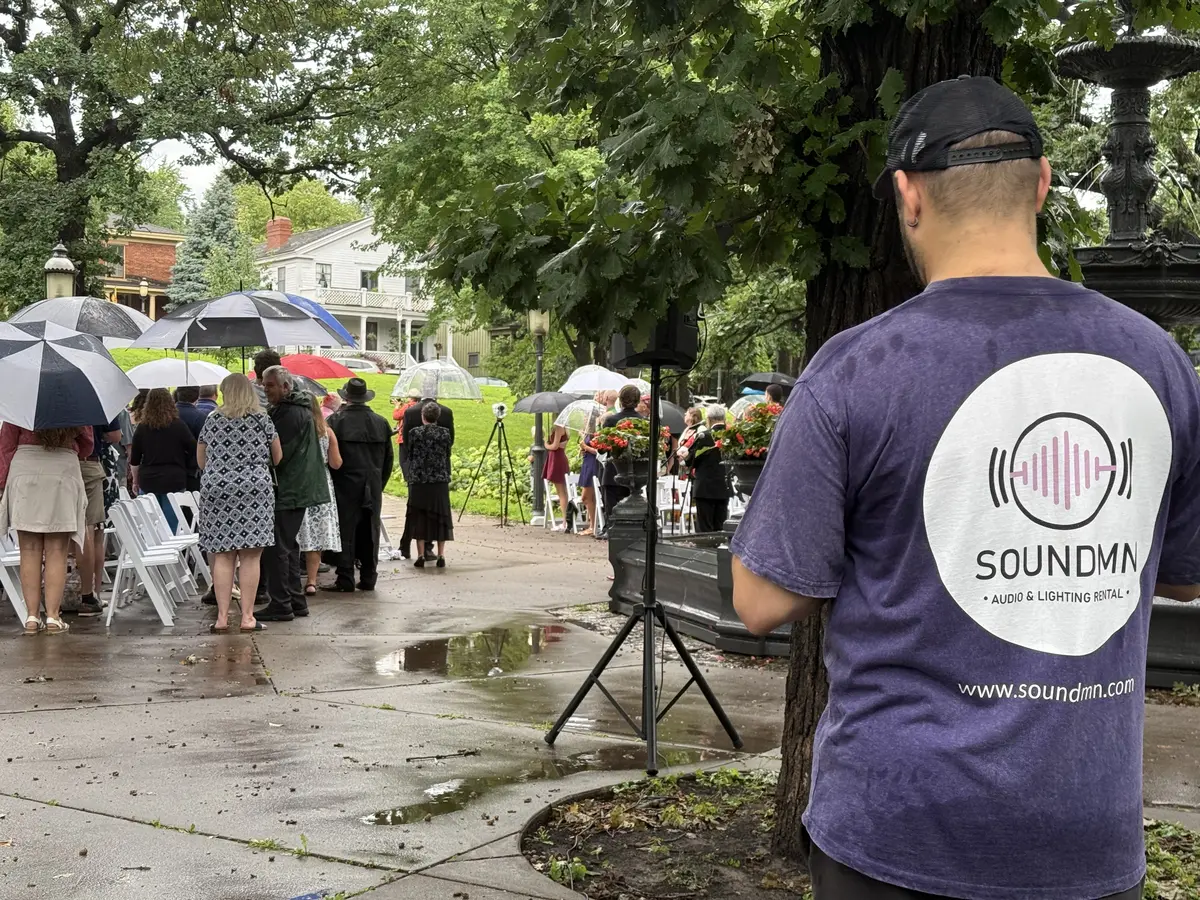
This might be the most important question on this list. Because there is a massive difference between "we set up the speakers and leave" and "we stay for the entire event."
Drop-off rental means:
- You're responsible for turning things on and off
- You're responsible for microphone levels during speeches
- You're responsible for troubleshooting if something goes wrong
- You're the sound engineer on your own wedding day
Full-service with an on-site technician means:
- Someone manages mic levels so Grandma's quiet voice is heard as clearly as the best man's booming delivery
- Music transitions happen on cue — ceremony processional starts at the exact right moment
- If the DJ controller freezes, there's a pro who can fix it in 60 seconds
- You don't think about sound once the entire night
Why it matters: On your wedding day, you should be dancing. Not adjusting a mixer.
Red flag:"We include setup and teardown." That's not the same as on-site support. Setup means they drop off at 2pm. Teardown means they pick up at midnight. What happens in between? That's the 8 hours that matter.
5. "Can I hear a sample of your system, or see a video from a real event?"
You wouldn't hire a photographer without seeing their portfolio. So why would you trust your audio to someone who can't show you what they sound like?
A good vendor should be able to show you:
- Video from actual events — not studio recordings, but real footage from real weddings
- Photos of their setup — how it looks at a venue (clean, professional, discreet — or a mess of cables?)
- A live demo — some vendors will let you hear their system in person before booking. This is rare but gold.
- Reviews mentioning sound quality— not just "great DJ!" but "the sound was incredible" or "every guest could hear the vows perfectly"
Why it matters: "Professional sound" looks and sounds different depending on who's behind the gear. A demo is worth a thousand promises.
Red flag:"Just trust us, we've done tons of weddings." Trust isn't a substitute for evidence. If they can't show you their work, ask yourself why.
6. "What's included in the price — and what's NOT?"
This is where budget quotes fall apart. Because $300 sounds great until you realize it doesn't include:
- Delivery (you pick up the speakers yourself)
- Setup (you figure out the cables)
- Subwoofers (no bass = no dancing)
- Microphones (speeches will be quiet)
- A sound check (just plug and pray)
- Pickup after the event (you return it the next day)
A transparent vendor will tell you exactly what's in the package before you ask:
- Equipment list: which speakers, how many subs, what mics
- Delivery and setup: included or extra?
- Sound check: do they tune the system to the room?
- On-site support: is someone there during the event?
- Pickup: what time, and what if the venue has a strict exit time?
- Travel fee:if you're outside their free delivery zone
Why it matters: A $1,200 full-service quote that includes everything is almost always a better deal than a $500 quote that doesn't include subwoofers, microphones, setup, or on-site support — because by the time you add those separately (if you even can), you're at $1,500 and still don't have the same quality.
Red flag:"Starting from $99." Nobody is delivering professional speakers to your wedding for $99. That's either consumer-grade gear, self-pickup, or a bait-and-switch where the real price appears after you're already committed.
7. "Ceremony and reception — are those priced separately?"
This one trips up more couples than any other question. Because most people assume that if they're renting sound for the wedding, it covers the whole day. Ceremony included.
Here's the reality: ceremony and reception are almost always separate services. Here's why:
Location:Your ceremony is in a garden. Your reception is in a barn 10 minutes away. You can't just pick up the speakers and move them — that takes time, a vehicle, and labor. It's essentially a second setup.
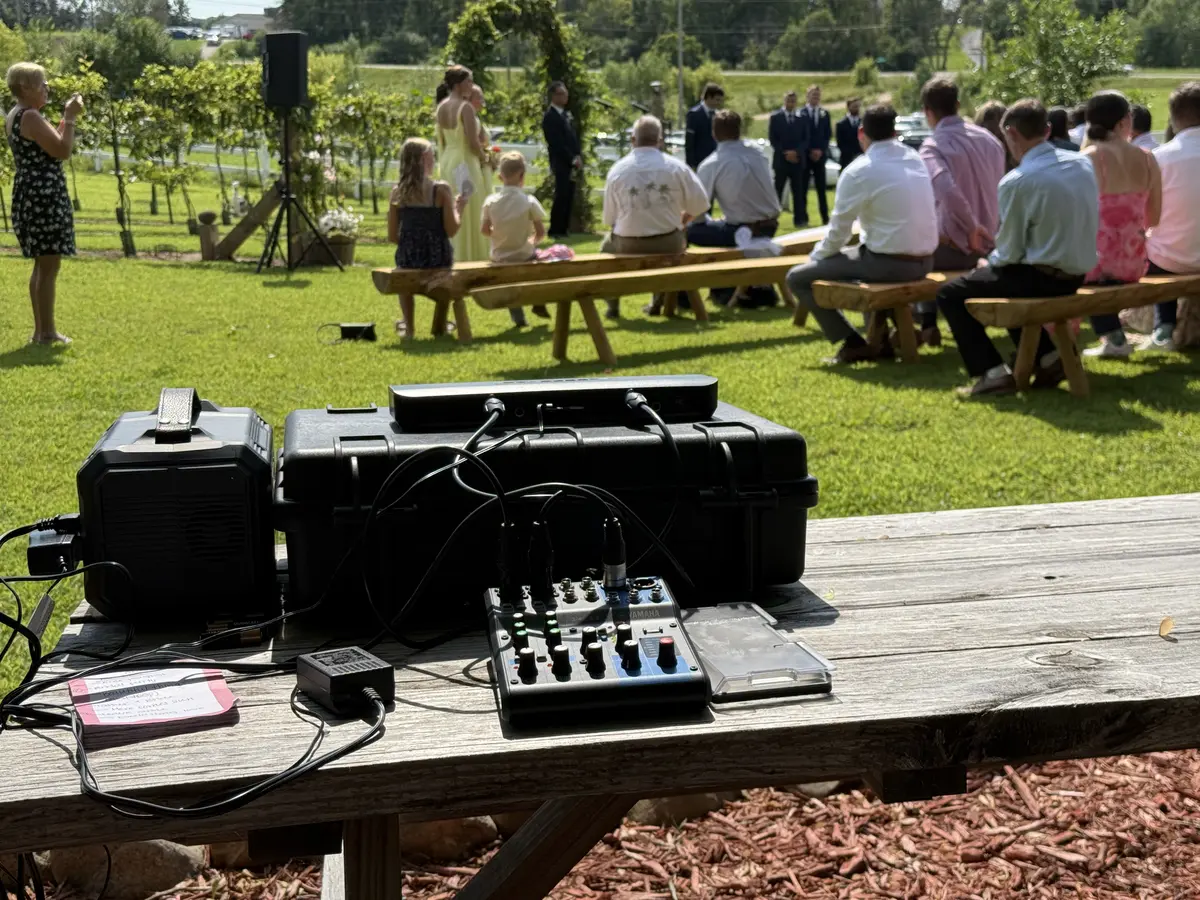
Equipment: An outdoor ceremony needs battery-powered speakers (no outlets in a field). A reception needs powerful speakers with subwoofers. These are different rigs.
People:A ceremony needs a technician who cues the processional music at the exact right moment, manages microphone levels for quiet voices and emotional pauses, and handles the recessional. That's a skilled human being — not a Spotify playlist on shuffle.
Even when both happen in the same room, the ceremony portion typically requires a separate technician fee because someone needs to run the ceremony-specific audio (processional, vows, recessional) before the reception even begins.
Why it matters: If you assume ceremony is "included" and the vendor doesn't correct you, you'll either show up on the day with no ceremony sound, or get a surprise charge a week before the wedding.
Red flag:"Yeah, we'll handle the whole day." Ask specifically: "Is the ceremony sound included? Is there a technician for the ceremony?" If they can't answer clearly, they haven't thought it through.
The Bottom Line
Your wedding happens once. The first dance happens once. The vows happen once. Grandma's speech — the one she's been practicing for three months — happens once.
None of these moments get a second take.
Sound is the invisible thread that holds all of it together. When it works, nobody notices. When it fails, everybody does. And the difference between a vendor who gets it right and one who doesn't isn't luck — it's preparation, equipment, and experience.
So before you book anyone, ask these seven questions. Write them down. Bring them to the meeting. Send them in an email. The vendors who welcome the questions are the ones you want. The ones who dodge them? Keep looking. Your wedding deserves better than a prayer and a pair of speakers.
Planning a Wedding in Minnesota?
SoundMN has handled 200+ events with a 5.0 Google rating. We deliver, set up, tune, and manage everything — so you don't think about sound once on your big day.
Get a Free Quote